Kingdom Match: Royal Adventure
- 4.4
- Rating
- 10.00M
- Installs
- Free
- Price
 Analysis by App-foxy
I spent time with Kingdom Match: Royal Adventure as a light, pick-up-and-play puzzle game, and its appeal became clear quickly: each session gives me a small rebuilding task, while the matching board provides the familiar moment-to-moment activity. It is designed for casual play rather than long, demanding sessions, so I can open it when I have a few spare minutes and still feel that I have moved something forward.
The game comes from GameeStudio and is free to start on Android. Its Teen content rating is worth noticing before downloading, especially for families choosing games for younger players. The current release is version 3.7, and it runs on devices using Android 7.0 or later. That broad compatibility makes it accessible on many older phones, although the experience will naturally depend on the device’s screen, speed, and available storage.
What makes this more than a plain match-three board is the royal rebuilding theme. I am not only clearing pieces for the sake of a score; the wider purpose is to restore a kingdom. That framing gives the individual puzzles a reason to exist, even when the basic action remains familiar. My overall impression is positive, but the game works best for people who enjoy gradual progress and repeating a comfortable puzzle rhythm rather than players looking for deep strategy or a highly demanding challenge.
You May Also Like

 Google Keep - Notes and lists
Google Keep’s Quiet Growth Shows the Appeal of Simpler Notes
As mobile work gets busier, Google Keep keeps winning a simple contest: capture a thought quickly, find it later, and get on with the day.

 Blood Strike: 2.5 Anniversary
Blood Strike’s Loadouts Turn Every Drop Into a Tactical Gamble
A close look at Blood Strike’s custom loadouts: how fast access to signature weapons reshapes its battle royale rhythm, rewards preparation, and narrows the gap between fights.

 Pandora - Music & Podcasts
Pandora’s Music Is Easy to Start, but Harder to Recover
Pandora’s strength is its low-effort path from a seed to a station. Its weak spot is how much confidence it asks you to place in connection, setup, and quiet recovery.

 8 Ball Pool
 Is Built on Rivalries, Rematches, and Routine
A close look at the rivalries, rematches, shared routines, and unanswered safety questions that turn a quick pool match into a persistent mobile community.

 Samsung Music
’s Quiet Strength Is Playing What You Already Own
Its reach comes less from spectacle than from dependable access to a personal library. That simplicity is both the app’s strongest retention engine and its ceiling.

 AccuWeather: Weather Radar
AccuWeather Review: A Quick, Clear Forecast for Everyday Decisions
For everyday plans, the best forecast is the one you can understand quickly. AccuWeather makes rain timing, radar, and local conditions easy to act on, with a few trade-offs.
More From Our News Desk



Small goals make the opening easy to understand
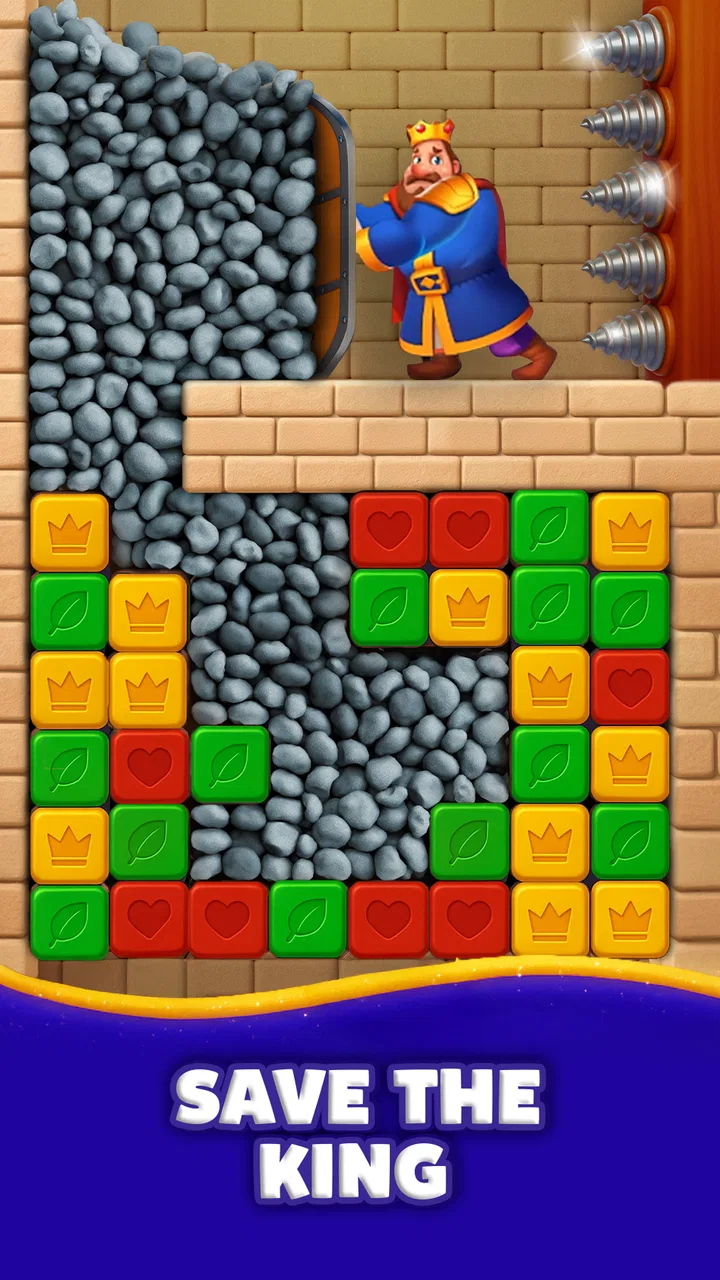
The early experience is strongest when I treat each puzzle as one step in a larger restoration project. Swapping pieces and forming matches is immediately understandable, so there is very little learning friction. I do not need to study a complicated control scheme before playing. The central loop communicates itself through action: look for a useful swap, make a match, and use the result to move the kingdom forward.
That simplicity is valuable on a phone. I can play with one hand, pause naturally between stages, and return without needing to remember a complicated chain of controls. The royal setting also gives the opening a little more personality than a board with no context. Rebuilding becomes a gentle reason to continue, particularly when I want something relaxing after work or during a short break.
A realistic use case is a ten-minute wait at a bus stop. I can complete a small amount of progress without committing to a long campaign, then put the phone away. The game’s casual identity suits that situation better than a strategy title that expects careful planning over a sustained session. It also feels more purposeful than endlessly replaying a score-based puzzle with no visible connection between one round and the next.
The early goals are accessible, but that accessibility has a trade-off. Players who expect a substantial story, character development, or a large amount of exploration may find the kingdom theme lighter than the word “adventure” suggests. The game’s main satisfaction comes from matching and progression, not from a complex narrative. I would recommend it to someone who wants a themed puzzle routine, not to someone choosing a role-playing game with extensive world-building.
What progress feels like during ordinary play
The clearest progress signal is the sense that successful puzzle play contributes to repairing or improving the kingdom. That connection matters because it turns otherwise separate boards into parts of one journey. Even when a level itself is straightforward, the larger rebuilding objective encourages me to try another round instead of closing the game immediately.
I found that this works best when I set a modest personal target, such as completing one more stage or making enough progress to reach the next visible improvement. Thinking in small targets keeps the game from feeling like an endless stream of identical boards. It also prevents me from treating every session as a test of maximum performance. The game is more enjoyable when progress is measured by steady advancement rather than by trying to perfect every move.
One useful habit is to avoid spending resources or accepting a difficult move too quickly when the board offers several possibilities. In a match game, the first obvious swap is not always the most helpful one. I get better results by scanning the whole board before touching it, checking whether a move can create a larger match or set up a useful follow-up. This is a simple discipline, but it gives the puzzles more thought without making them feel like a serious strategy exercise.
That is one of the game’s less obvious strengths: it can sit between pure reflex play and heavy planning. I can play casually, yet I still have room to improve my decision-making. The best sessions are not necessarily the fastest ones. They are the sessions where I notice a better arrangement, delay a tempting move, and see the board produce a more useful result.
At the same time, I would not describe the progression as equally satisfying for every player. If you need constant novelty, visible complexity, or a strong sense of mastery, the rebuilding theme may not be enough on its own. Its progress signals are gentle. They support a relaxed routine, but they do not create the same urgency as a competitive leaderboard or a demanding puzzle campaign.
How the challenge develops without becoming intimidating
The challenge is most comfortable when approached as a gradual curve. Early boards serve as a low-pressure introduction to swapping and matching, while later play asks for more awareness of the board and the consequences of each move. I appreciate that this kind of increase lets me settle into the controls before expecting more careful choices.
The important distinction is that difficulty in this type of game is not only about making matches. It is about recognizing which match helps the immediate objective and which one merely looks attractive. A player who acts quickly may clear pieces but leave the board in an awkward position. A player who pauses to inspect possible chains can often make a more efficient move. That gives the game a useful layer of judgment even though its basic rules remain approachable.
My advice is to slow down whenever a board looks unusually crowded or when several possible swaps seem equally appealing. I first look for moves that open space, then consider whether the resulting pieces create another opportunity. This workflow is more reliable than chasing the largest-looking match without considering what happens afterward. It is also a good way to make the game last longer without needing to raise the difficulty artificially.
The casual format will suit players who want challenge in short bursts. It is less suitable for people who want every stage to demand precise, high-level planning. The game’s appeal depends on moderation: enough resistance to make a successful board feel earned, but not so much that a short session becomes exhausting. If you prefer relaxing progression with occasional moments that require attention, the balance is appealing. If you want a puzzle game built around relentless difficulty, another option in the category may be a better fit.
There is also a practical device consideration. Because the game supports Android 7.0 and later, it can reach older hardware, but that does not guarantee identical comfort on every phone. On a smaller display, spotting possible matches may take more concentration, and older devices may feel less responsive than newer ones. I would keep the screen clean and play with enough brightness to distinguish the pieces clearly, especially during longer sessions.
Where the free model creates pressure
The game is free to download, which makes trying it straightforward, but it includes optional purchases priced from $0.99 to $8.99 per item. That matters because casual puzzle games often rely on the temptation to speed up progress or make a difficult moment easier. I prefer to decide in advance whether I am playing entirely for free or whether I am comfortable spending occasionally. That boundary helps keep a short relaxation game from becoming an unplanned expense.
I would not install this expecting every part of the experience to feel completely free from commercial pressure. The presence of in-app purchases means players should pay attention to the purchase flow and use device-level spending controls when necessary. This is especially important if the phone is shared with children, even though the game itself carries a Teen rating.
For me, the best approach is to judge each puzzle on its own before considering any optional help. If I am stuck, I first replay the board mentally, look for a different opening move, and take a short break. Returning with fresh attention is often more satisfying than immediately paying to bypass friction. This also preserves the main reason to play: solving the matching problem and seeing the kingdom progress as a result.
The free model is therefore both an advantage and a limitation. It lowers the barrier to entry, and I can discover whether the theme and pacing suit me without paying upfront. However, players who dislike any form of optional spending may feel more comfortable with a one-time-purchase puzzle game. That alternative usually offers a clearer cost from the beginning, while this game gives easier access but asks the player to manage temptation during continued play.
Who will enjoy the pacing, and who should skip it
Kingdom Match is a strong fit for people who like familiar matching mechanics with a light restoration goal attached. It works particularly well for short sessions, relaxed evening play, and anyone who enjoys watching a setting develop gradually. I can imagine recommending it to a friend who wants something more engaging than scrolling but less demanding than a competitive game.
It is also a reasonable choice for players using older Android phones, since the minimum operating system is Android 7.0. The game has reached more than five million installs and holds an average rating of 4.3 from roughly ninety-seven thousand ratings, which suggests that its accessible format has found a broad audience. Those figures do not replace personal experience, but they do place the game among the more established casual choices rather than an obscure experiment.
I would steer away from it if you need deep strategic systems, a rich narrative, or a completely purchase-free environment. Players who become frustrated by repeated matching boards may also lose interest once the novelty of rebuilding wears off. In that case, a story-focused adventure game would offer more character and exploration, while a premium puzzle title would provide a clearer spending model.
Compared with a standard match-three alternative, this game’s main advantage is the kingdom context. The rebuilding objective gives me a reason to care about the next stage. Compared with a heavier strategy game, its advantage is ease: I can begin playing immediately and stop without losing a complicated plan. The trade-off is that it does not appear aimed at players who want a large set of interconnected systems. Its identity is narrower, but that narrowness helps it remain approachable.
The Teen rating is another point I would consider before recommending it to a younger player. Parents should check the game directly on the intended device and decide whether its content and optional purchases are appropriate for their household. For adults and teens who understand the purchase model, the rating should not be a major obstacle, but it is still part of the decision rather than a detail to ignore.
My verdict on the long-term progression
After playing it as a casual routine, I see the progression as steady rather than dramatic. The game’s goals encourage me to complete another board, and the kingdom theme gives those completions a visible sense of purpose. Its challenge is strongest when I take time to plan swaps instead of treating every board as a reflex exercise. That combination is enough to sustain regular short sessions for the right audience.
The pacing does not depend on constant intensity. Instead, it works through small rewards, familiar controls, and the quiet satisfaction of restoring something over time. I think that is the correct design choice for a casual game, but it also explains why some players will stop sooner than others. If the rebuilding layer does not hold your attention, the underlying matching loop may feel too repetitive to carry the full experience by itself.
My final recommendation is to try it if you want a free royal puzzle game that fits naturally into spare moments. Keep your expectations focused on matching, gradual kingdom progress, and light decision-making. Play slowly enough to inspect the board, set your own stopping points, and treat optional purchases as a choice rather than a requirement. With that mindset, Kingdom Match: Royal Adventure offers an easygoing way to turn a few idle minutes into visible progress.
It is not the right pick for every puzzle fan, and I would choose a premium or more strategic alternative when I wanted greater depth or a fixed cost. But for a player who enjoys accessible goals, a manageable difficulty curve, and a themed reason to keep going, GameeStudio’s game earns a recommendation. Its strongest quality is not complexity; it is the way it makes a familiar matching activity feel connected to a simple, satisfying rebuilding journey.
FAQs for Kingdom Match: Royal Adventure
01What is the main objective of Kingdom Match: Royal Adventure?
Kingdom Match: Royal Adventure is a puzzle game where players combine tiles to solve challenging puzzles. The main objective is to restore and expand your kingdom by completing levels. As you progress, you unlock new areas and features, making strategic decisions to optimize your kingdom's growth.
02Are there in-app purchases in Kingdom Match: Royal Adventure?
Yes, Kingdom Match: Royal Adventure offers in-app purchases. Players can buy items or currency to help them progress faster through the game. While it's possible to play without spending money, these purchases can enhance the gaming experience by providing additional resources or special boosters.
03Is an internet connection required to play Kingdom Match: Royal Adventure?
While Kingdom Match: Royal Adventure can be played offline for the puzzle levels, some features—such as events, leaderboards, and special updates—require an internet connection. Connecting online also allows you to save your progress to the cloud, ensuring you don't lose your game data.
04How does the energy system work in Kingdom Match: Royal Adventure?
Kingdom Match: Royal Adventure uses an energy system where each level attempt costs a certain amount of energy. Energy replenishes over time, or players can purchase more through in-app purchases. Managing your energy wisely is crucial to maximizing your gameplay time and progress.
05What age group is Kingdom Match: Royal Adventure suitable for?
Kingdom Match: Royal Adventure is designed for players aged 8 and up. Its intuitive gameplay and colorful graphics make it accessible to younger audiences, while the strategic elements and challenging puzzles offer depth for older players. Parental guidance may be recommended for in-app purchases.
Pros
- Engaging storyline with royal themes.
- Beautiful graphics and animations.
- Challenging puzzles to solve.
- Regular updates with new levels.
- Free to play with optional purchases.
Cons
- Requires constant internet connection.
- Ads can be intrusive at times.
- In-app purchases can be expensive.
- Drains battery quickly on older devices.
- Occasional bugs in certain levels.

Kingdom Match: Royal Adventure
Gallery